November 23, 2026 by Mid Atlantic Regional Center
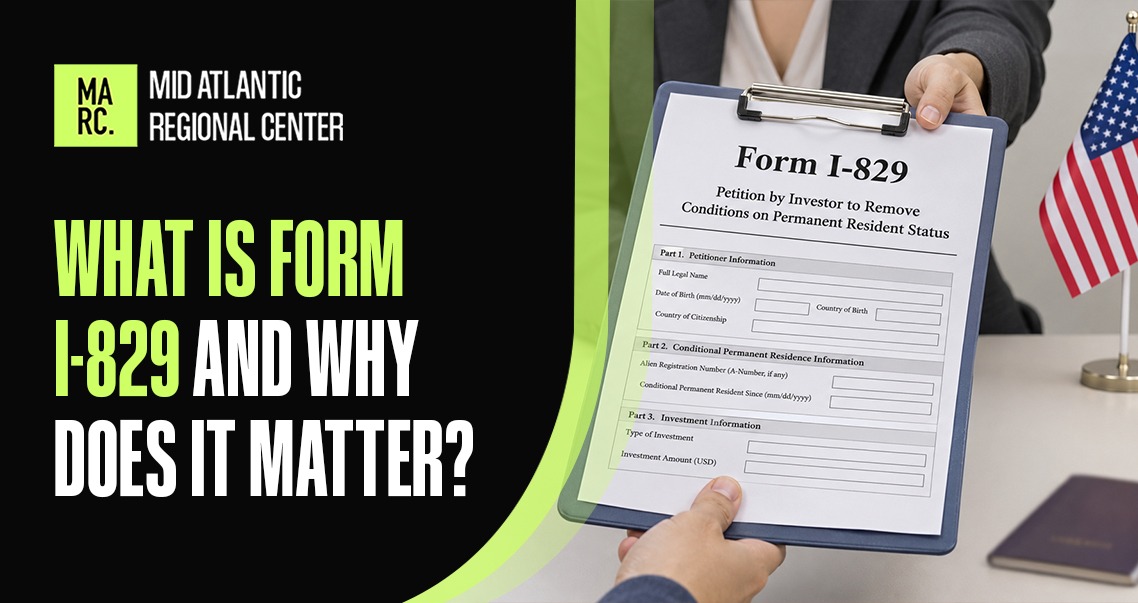
Form I-829 is the petition EB-5 investors generally use to request removal of the conditions on their permanent resident status after completing the required period of conditional residence.Its official name is Form I-829, Petition by Investor to Remove Conditions on Permanent Resident Status.
For an EB-5 investor, receiving conditional permanent residence is not the end of the immigration process.
The investor generally receives permanent resident status on a conditional basis for two years. Near the end of that period, Form I-829 becomes the key filing used to demonstrate that applicable EB-5 requirements have been satisfied.
If USCIS approves the petition, the conditions are removed and the investor becomes an unconditional lawful permanent resident.
If you've spent any time researching paths to U.S. permanent residency, you've probably come across the term "EB-5 visa." Unlike most U.S. green card categories, EB-5 is not based on a job offer or family relationship. It's based on capital investment. This guide breaks down what the program actually is, where it came from, and who it's designed for without the jargon.
Form I-829 is a USCIS petition specifically associated with EB-5 conditional permanent residents.
Its purpose is to allow an immigrant investor to show that the conditions attached to permanent resident status should be removed.
An eligible spouse and children who received conditional residence through the investor's EB-5 case may generally also be included where applicable.
At this stage, USCIS is no longer primarily evaluating whether the investor proposed a qualifying investment. Instead, the agency examines evidence concerning what actually happened after the investment was made.
This makes Form I-829 different from an earlier petition such as Form I-526E.
Form I-829 is generally filed during the 90-day period immediately before the second anniversary of the date the investor obtained conditional permanent resident status.
The timing is based on when conditional residence began, not when Form I-526E was filed or approved.
For example, if an investor became a conditional permanent resident on December 1, 2026, the relevant I-829 filing window would generally fall during the 90 days before December 1, 2028.
Because filing dates are important, investors should confirm their exact filing window with qualified immigration counsel rather than relying solely on an estimate.
Current filing requirements and instructions are available directly from the USCIS Form I-829 page.
Form I-829 matters because EB-5 permanent residence initially comes with conditions.
An investor does not simply wait for those conditions to disappear after two years. The investor generally must affirmatively request removal of the conditions by filing Form I-829 and providing supporting evidence.
If USCIS approves the petition, the conditions on permanent resident status are removed.
If the investor fails to file Form I-829 within the required period, USCIS states that conditional permanent resident status may be terminated, subject to limited provisions that may apply to certain late filings involving good cause and extenuating circumstances.
The I-829 filing is therefore a critical compliance step rather than an optional administrative formality.
USCIS evaluates whether the investor has satisfied the applicable EB-5 requirements for removal of conditions.Although every case can differ, the review generally focuses on several important areas.
1. The Qualifying Investment
USCIS examines evidence concerning the investor's capital investment and whether the applicable EB-5 investment requirements were satisfied.
The petition may include documentation relating to the new commercial enterprise, capital contributions, financial records, and other evidence relevant to the investment.
2. Sustaining the Investment
The I-829 stage may also involve demonstrating compliance with applicable requirements concerning the investor's investment during the required period.
The exact rules can depend on when the investment was made and which version of the EB-5 law applies.
Investors should therefore obtain case-specific advice instead of assuming that every EB-5 case follows identical sustainment rules.
3. Job Creation
Job creation is another important component of the I-829 review.EB-5 generally requires qualifying investment activity to support the required number of jobs. Depending on the investment structure, the evidence and method used to demonstrate those jobs may differ.
For Regional Center investors, qualifying job creation may involve economic methodologies associated with the project rather than simply counting employees hired directly by the investor.
The project's documentation and job creation performance may therefore remain important even after the investor has already received conditional permanent residence.
For purposes of removing the conditions associated with EB-5 permanent residence, Form I-829 is generally the final major immigration petition.
The basic progression can be summarized as:
EB-5 immigrant petition → Conditional permanent residence → Form I-829 → Removal of conditions
Once Form I-829 is approved, the investor's residence is no longer conditional based on the EB-5 investment.
This article focuses specifically on the removal-of-conditions stage. Investors who want an overview of the earlier stages can review MARC's EB-5 process separately.
After USCIS accepts a properly filed I-829 petition, the investor receives a receipt notice.
According to current USCIS instructions, timely filing can automatically extend the investor's conditional permanent resident status for the period indicated on the receipt notice while the petition remains pending.
The investor should keep the receipt notice together with the Permanent Resident Card because those documents may be used as evidence of continuing status.
During adjudication, USCIS may review the petition and supporting documents and may request additional information if necessary.
Possible outcomes include:
• Approval
• Request for Evidence
• Other USCIS notices
• Denial
Processing times can change substantially, so investors should check current USCIS processing times rather than relying on a fixed estimate in an article.
Certain eligible family members who obtained conditional permanent residence through the principal EB-5 investor may generally be included on the investor's Form I-829.
This may include a conditional permanent resident spouse and children.
USCIS instructions also address circumstances in which certain family members may file separately.
Because family situations can change during the conditional residence period, including through divorce, marriage, aging out concerns, or the death of a principal investor, individual legal guidance can be particularly important.
When USCIS approves Form I-829, the conditions attached to the investor's permanent resident status are removed.
The investor becomes an unconditional lawful permanent resident.
Eligible family members included in the petition may also have the conditions removed from their status.This is a major milestone because the investor's permanent resident status is no longer dependent on the two-year EB-5 conditional period.
Approval of Form I-829 does not automatically make someone a U.S. citizen. Naturalization is a separate immigration process with its own eligibility requirements.
USCIS generally expects the petition to be filed during the required 90-day filing period.
If an investor fails to file on time, conditional permanent resident status may be terminated.
However, USCIS instructions provide that a late petition may potentially be considered where the investor demonstrates that the failure to file on time resulted from good cause and extenuating circumstances.
Investors facing a missed deadline should seek qualified immigration advice immediately rather than assuming the issue can be corrected automatically.
The exact evidence depends on the investor and project, but documentation may relate to areas such as:
1. The investor's conditional permanent resident status
2. The new commercial enterprise
3. Capital investment records
4. Project financial records
5. Evidence related to job creation
6. Business or project activity
7. Relevant tax or financial documentation
8. Evidence identifying eligible derivative family members
Regional Center investors may rely in part on project-level records maintained by the Regional Center, new commercial enterprise, job-creating entity, or other parties involved with the project.
This is one reason ongoing project reporting and recordkeeping can remain important after an investor receives conditional residence.Investors reviewing Regional Center opportunities can learn more about EB-5 investments.
What is Form I-829 used for?
Form I-829 is used by qualifying EB-5 investors to request removal of the conditions on permanent resident status.
When should Form I-829 be filed?
It is generally filed during the 90-day period immediately before the second anniversary of obtaining conditional permanent resident status.
Is Form I-829 the same as Form I-526E?
No. Form I-526E is generally used earlier by a Regional Center investor to seek EB-5 immigrant classification. Form I-829 is filed later to request removal of conditions from permanent residence.
What happens while I-829 is pending?
A timely filed petition can extend conditional permanent resident status for the period stated on the USCIS receipt notice while the petition is being adjudicated.
Does I-829 approval give an investor a 10-year Green Card?
Approval removes the EB-5 conditions from permanent resident status. USCIS can then provide evidence of the investor's unconditional lawful permanent resident status in accordance with its procedures.
Does I-829 approval mean the investor is a U.S. citizen?
No. Lawful permanent residence and U.S. citizenship are different statuses. Naturalization requires a separate application and eligibility determination.
Form I-829 is the petition that qualifying EB-5 investors generally file near the end of their two-year conditional residence period to request removal of the conditions on permanent resident status.
USCIS reviews whether applicable EB-5 requirements have been satisfied, including relevant investment and job creation requirements.
The petition is generally filed within the 90-day period before the second anniversary of obtaining conditional residence. Timely filing is important because failure to file can place the investor's immigration status at risk.
If USCIS approves Form I-829, the conditions are removed and the investor becomes an unconditional lawful permanent resident.
Because filing deadlines, investment requirements, family circumstances, and supporting evidence can vary by case, investors should work with qualified U.S. immigration counsel when preparing their petition.
Disclaimer: This article is for general informational purposes only and does not constitute immigration, legal, tax, securities, or investment advice. EB-5 rules, USCIS forms, fees, filing procedures, and evidentiary requirements may change. Investors should review current USCIS guidance and obtain advice based on their individual circumstances.
